Tuesday, July 3, 2018

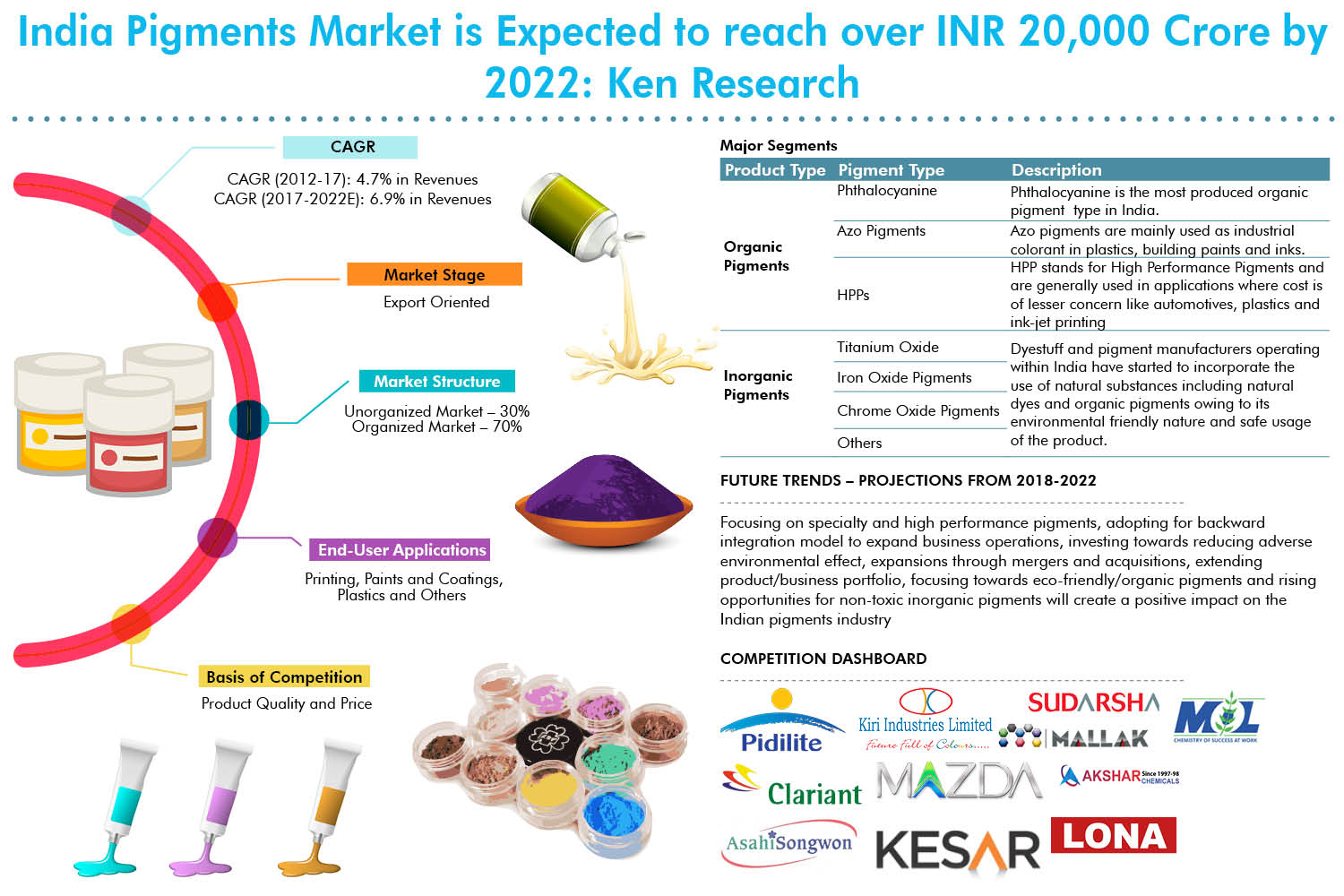
India Pigments Market is expected to reach over INR 20,000 Crore by the year ending 2022: Ken Research

Indian pigment manufacturers are expanding their production capacities, given their low cost advantage with increasing focus on HPP and other specialized pigments such as metallic and pearlescent, used in automotives and other industrial coatings.
Pigment manufacturers in India, especially the organized sector players have started to focus on backward integration to gain a competitive advantage over others.
The growing trend of using aluminum based pigments in India has promoted the development of superior quality coating solutions, intense colors and new metallic shades which are further expected to boost the demand for metallic pigments in automotive and construction sector.

Surging pigment end-user expectations in terms of price and quality consciousness has forced manufacturers operating within the organized sector to invest more on R&D in order to develop both organic as well inorganic pigment emulsions within the regulatory framework and reasonable pricing in the coming years. Additionally, they have been opting for backward integration model therefore, procuring raw material in advance and producing in accordance with customer needs. As a result, it will also help them to reduce their overall cost of manufacturing.
Increasing consumer preference towards aesthetic finishes in passenger cars coupled with growth in the country’s automobile industry is further estimated to generate additional demand for metallic and pearlescent effect pigments towards paints and coating applications in India. Small and niche players can focus towards this product type owing to growing trend of adopting high performance organic pigments and the continuous displacement of heavy toxic metal pigments such as lead, chromium and others.
Analysts at Ken Research in their latest publication “India Pigments Market Outlook to 2022 – By Organic Pigments (Azo Pigments – Yellow, Red, Blue and Orange; Phthalocyanine – Green and Blue and HPP – Red, Orange and Yellow) and Inorganic Pigments (Titanium Oxide, Iron Oxide, Chrome Oxide and Others) and CPC Blue Crude Market” believe that focusing on specialty and high performance pigments, adopting for backward integration model to expand business operations, investing towards reducing adverse environmental effect, expansions through mergers and acquisitions, extending product/business portfolio, focusing towards eco-friendly/organic pigments and rising opportunities for non-toxic inorganic pigments will create a positive impact on the Indian pigments industry.
India market is expected to register a positive CAGR of 5.5% for pigments market during the forecast period 2017-2022E. Changes taking place in Chinese chemical industry has also presented several opportunities for Indian manufacturers to increase their exports, especially pigment emulsions towards major countries including US, Bangladesh, Germany, Turkey, China, Brazil, Italy and others.
Key Topics Covered in the report
India Phthalocyanine Pigment Market
Pricing Analysis India Pigments
Global Pigments Sales
Global Pigments Market
India Pigments Industry
Pigment Exports from India
Global Organic Pigment Forecast
Major Players in Pigments Industry
India Pigments Trends
Pigment Imports to India
Type of Pigments Sold in India
Major Selling Pigments in India
Inorganic Pigments Market India
Pigments Market Growth in India
Overall Chemicals Market in India
Export Sales Organic Pigment India
High Performance Pigments and Specialty Pigments Market
Companies Covered
Clariant Chemicals
Meghmani Organics
Sudarshan Chemicals
Asahi Songwon
Poddar Pigments
Kesar Petro products
Mazda Colors
Mallak Pigments
Pidilite Industries Limited
Phthalo Colors and Chemicals
Lona Industries
Gharda Chemicals Limited
Vibfast Pigments Pvt. Ltd.
For More Information, Refer to the Link below
Related Reports:
Contact Us:
Ken Research 
Ankur Gupta, Head Marketing & Communications
+91-9015378249

Wireless Charging Furniture Market Outlook: Ken Research

The furniture industry today is one of the leading industries that incorporate technology in their products. Today wireless charging has grown more than ever. More and more devices are coming with built-in wireless charging and others with accessories to allow wireless charging. Furniture Market Research Reports Consulting highlights the fact that customers today are demanding furniture that is innovative whilst being comfortable.

Wireless charging furniture has been a result of technology being incorporated into furniture. Such furniture is mainly being developed to cater to the wireless charging feature of modern cellular phones such as Apple i-Phone X and Samsung Galaxy S9 among others. There have been recent developments in this respect-

1.      London based Fonesalesman has developed FurniQi. Which is a wireless charging side table that aims to function efficiently while still looking elegant. The simple bamboo design features a Qi wireless charging spot marked with a subtle laser engraving capable of charging a range of phones and devices. It also has an optional audible notification, making the table simple to use when the lights are off.

2.      Argentina based smart furniture company Curvilux has recently launched its modern nightstand which has a built in wireless charger.

3.      Sweden’s IKEA has developed its Wireless Charging Collection which has increased the scope of wireless charging by incorporating it in a wide range of furniture items that go beyond lamps and nightstands to charging pads which can be installed anywhere.

4.      Ecommerce companies are also investing in the field Amazon has also taken steps in this direction and has launched a few of its original furniture pieces that adhere to the concept of wireless charging. The Ampulla Charging Lamp and Sierra Modern Home Smart Table are some examples. Even eBay has developed products like Wooden Portable Speaker and Woody Wireless Charger.

Furniture Business Review reveals that most of the developments taking place in wireless charging furniture are made either by tech giants or e-commerce companies. This constantly developing field has led to a business partnership between the two for instance; Curvilux launched its nightstand on Indiegogo. Moreover, many discounts and offers are also being laid on such products to give incentive to the public to buy them. IKEA is seen as a major player in technological developments and its products and future projects that incorporate the concept of wireless charging are believed to be key drivers for future growth. Apart from major tech giants wireless charging is also capturing the attention of educational institutions like Stanford University and big companies like Disney. The former is working on wireless transmission whereas the latter has developed a wireless charging room.

Furniture as an industry is growing rapidly and incorporating technical developments like wireless charging is expected to further its growth. The current scenario may suggest modest use of wireless charging furniture but its technological innovation is capturing the attention of many people. Along with already established world leaders like IKEA, many other companies and institutions are also experimenting with the technology, further highlighting its immense potential. Wireless charging is said to be the next step in innovation and wireless charging furniture is said to pave the way for future developments.

For more information, click on the link below:

Contact Us:
Ken Research
Ankur Gupta, Head Marketing & Communications
0124-4230204

Glass Beer Bottles to Dominate Asian Beer Bottle Market-Ken Research


Beer is one of the most popular alcoholic drinks consumed in Asia. It is also the oldest beverage prepared by fermentation of grains. Many variants of beer are available in Asian market with varying tastes and flavours. Modernization and increase in disposable incomes has led to increased consumption of beer which indirectly increased the market for beer bottles. Beer in Asia is usually packed in metal cans, glass bottles, draft, other packing such as aluminium bottles, plastic bottles, and refill glass bottles. Now-a-days, beer packing is done majorly in cans and glass bottles. The cans and glass bottles have increased in volume, but, cans occupy a major share from the past few years compared to glass bottles. Almost all consumers demand for quality, natural and clean labelled beer. Asian consumers care about maintenance of glass bottles that are 100% recyclable. Beer consumption growth rate has increased rapidly due to excellent demand and protective qualities of glass packaging.
According to the study “Asia Beer Bottle Industry Situation and Prospects Research report”, almost all the beer bottles vary in size and shape, however, brown or green glass is the commonly used material which reduces spoilage from light, especially ultraviolet rays. The widely established alternatives to glass containers for beer in retail sales are beverage cans and aluminium bottles. The unique properties of glass beer bottles guarantee fullest enjoyment. Glass beer bottles optimally preserve the beer’s carbon dioxide content for a longer time, ensuring that the taste and quality of the beer remains the same. Glass beer bottles are classified into various types such as amber (brown) glass beer bottles, white flint (clear) glass beer bottles, green glass beer bottles and other types. Beer is easily spoilt when exposed to light, heat and oxygen. Cans are another alternative for beer packaging because they do not let in any light and are completely machine sealed for better storage. The standard brown-hued glass bottle keeps out UV rays, but doesn’t prevent all light. Cans are more portable as it is easy to get the beverage cooled faster and easy to handle while travelling. Cans are more often used in craft beer packaging in recent years, but glass bottles are still the most common traditional packaging format of beer. Labelling a glass bottle is easy as per beer industry standards compare to labelling on cans which is a logistical challenge for all the manufacturers.
Consumer’s first choice for reliable, healthy, sustainable and premium beer products will continue to keep glass bottle packing in strong demand among all brands that hope to meet the expectations and make a distinction of their products on the shelves in Asian markets. The growth in beverages is likely to remain tough, with majority of the beer brands embracing glass bottle packaging to meet consumer’s expectations. At the same time, PET bottles attracted the Asian market for beverages. The PET bottle manufacturers manufacture bottles with detailed specifications for storage of beer. Changing or switching to PET beer bottles can witness more outstanding results in Asia.
Majority of the manufacturers will benefit in terms of cost reduction, lower energy consumption and fewer harmful emissions during transportation. Asian countries are expected to contribute to the consumption of PET bottles for the storage of beer in the next few years. The leading players in Asian beer bottles are O-I, Ardagh Group, Beatson Clark, Orora, Wiegand-Glas, Encirc Glass, Hillebrandt Glas, Systempack, All American Containers, Encore Glass, Sisecam, Huaxing glass, SuoKun Glass Grou, Yantai Changyu Glass, Jintai boli, Yantai NBC Glass Packaging, SHENZHEN TONGCHAN GROUP, Sino-Belgian Beer (Suzhou), ShangHai Misa Glass, Taiwan Glass and Sichuan Shubo (Group).
Modernization, consumption rate, high disposable incomes, and increased consumption by younger generation, along with heavy taxation, legal regulations, and health issues of beer consumption are slowing the growth of beer and beer bottles market. Various innovative products, such as flavoured and crafted beer are demanding for imported beer along with glass beer bottles. The beer bottle market is based on the product type, category, and packing. However, the glass bottles market is expected to grow at a steady rate over the next few years competing with PET bottle market. Asia’s beer metal cans may anticipate a second highest growth due to flexibility to handle which will witness a massive growth in terms of volume sales compared to volume sales of glass beer bottles.
To know more, click on the link below:
Related Reports:
Contact Us:
Ken Research
Ankur Gupta, Head Marketing & Communications
+91-9015378249

Evolution in Organic Barbecue Sauces and Rubs to Drive Asian Markets: Ken Research

Barbecue sauce is a flavoring ingredient used as a seasoning for smoked meat, vegetables and other foods products to enhance the organoleptic property of the foods. Barbecue sauces are very popular according to the geography as they incline to tenderize the meat and provide them with spicy flavour. Apart from beings used as seasoning or marinades, sweet barbecue sauce is used as dips. The increasing demand for natural or organic food products in Asian countries has driven the market for organic barbecue sauces which are now gaining popularity. Barbecue rubs are also spices and herbs blended in a different way to add flavour to meat cuisines. Rubs are mostly in dry form but not necessarily in wet form.

Asia’s barbecue sauce and rubs market is categorised into organic and non-organic based on the product type. Organic barbeque sauce market is expected to increase as more Asian consumers are demanding for chemical free food products. Manufacturers of organic food products are adopting natural food ingredients and various organic processes to meet the increasing consumer demands. Barbecue sauce and rubs are available at supermarkets/hypermarkets, online retail, specialty stores, and wholesale retailers. Supermarket/hypermarket account for more market share in the sale of barbecue sauces and rubs due to more consumption and popularity of smoked/barbecued food amongst the Asian population.

According to the study “Asia BBQ Sauces & Rubs Industry Situation and Prospects Research Report”, Asian population is focussing on healthy lifestyle and general health awareness is encouraging the consumption of foods rich in protein and less fat. Use of taste enhancers is increasing in Asia’s food industries which demands barbecue sauces and rubs. Deep fried food destroys the potent protein content and increases cholesterol in the body, making it unsuitable as a healthy diet. Therefore, there is an increasing trend of consumption of barbecued or smoked meat and vegetables. The major ingredient in barbecue sauces and rubs is tomato which is rich in anti-oxidant content possessing anti-cancer properties. Barbecue sauces and rubs are used at home cooking as well as in commercial cooking such as restaurants and hotels.

Modernization has made Asian people rely on the readymade food products such as barbecue marinades, rubs and sauces encouraging a drastic growth in this sector. Almost all the available barbecue sauce enhances the flavour of the food without hampering the nutritional value which is an added advantage of using ready to use barbecue sauce. Barbecue sauces are available in the low-fat form which is attracting health conscious consumers.

 The unique blend of flavours has witnessed a growth in the barbecue sauces and rubs market and more players are expected to enter the Asian markets. The leading players in Asia’s barbecue sauces and rubs market are Kraft, Sweet Baby Rays, Croix Valley, KC Masterpiece, Stubbs, Victory Lane BBQ, Flagship, Rufus Teague, Traeger, Sucklebusters, Famous Daves, Open Pit, ConAgra Foods, Oakridge BBQ Rub, Aliminter S.A., and Gyma.

The increasing consumption of meat, demand for better tasting food, continuous rise in the disposable incomes are a few factors that are encouraging the growth of barbecue sauces and rubs market in Asia. However, the growth of the barbecue sauces and rubs market may be hindered due to a lot of adulterated items available in the market. Rapid modernization and increasing population in Asian countries will witness a continuing growth in barbecue sauces and rubs market over the next few years.

To know more, click on the link below:

Related Reports:


Contact Us:
Ken Research
Ankur Gupta, Head Marketing & Communications
0124-4230204

Convergence Of Machine Learning With Education Sector Market Outlook : Ken Research


Education Business Review suggests that the machine learning in education sector is expected to grow at a CAGR of 46.7%, globally. Education with traditional methods is an outdated process that requires extensive human effort from both course instructors as well as students. The instructors need to prepare teaching materials, manually grade students’ homework, and provide feedback to the students on their learning progress. Students, on the other hand, typically go through an extremely burdensome “one-size-fits-all” learning process that is not personalized to their abilities, needs, and learning context. Education industry is moving away from traditional book learning techniques that do not reflect the complex reality to more immersive methodology involving all the students who tend to learn and grasp concepts at different speeds. Education industry has been revolutionized by introduction of the concept of machine learning. The use of digital books and adaptive learning allows for a much more tailored and customizable learning experience because teachers have the data on what students are exactly consuming and how they’re coming up with what they have to learn.
The use of this technology can help institutions to make student path predictions. Machine learning shall analyze the repetitive actions of the students and helps institutions understand the problem being faced by the student and if immediate action is required on the student. For instance Market Research Reports for Education reveals that if a student is facing problems in writing then the machine shall help the teacher understand how grave the situation is and whether the student will be able to overcome this problem with immediate action or with proper time and attention. The teachers shall not have to undergo tedious grading mechanism and can devote adequate time to important activities. With the introduction of machines into the grading mechanism, the chances of biasness towards any student are eliminated. The machine can analyze the current curriculum along with the student’s performance and suggest changes in the curriculum if any are actually needed. Not only this, it can even provide insights as to the changes in teaching mechanism or even introduction of newer more better methods. Machine Learning has the potential of organizing the content and curriculums in a better way, as it can analyze what works best and which concepts are understood better with certain techniques. As a result, the efficiency of education grows significantly and the students are happy because they get to learn important things in a way that they are comfortable with.
Machine learning software’s are being developed by many companies and startups around the world. Some major startups working in this segment are Querium Coporation (US), Metacog (UK), Bridge U (UK), Volley Labs (US) and Symbolabs (Israel). Symbolab’s machine learning algorithms understand the context and meaning of the queries to assist to provide a much better response to the queries.
With a high growth rate this technology shall witness huge growth in the coming 10 years because of developments in both machine learning and artificial intelligence. Machine learning in education is making it possible for people everywhere to access a wide variety of information to better educate them from an early age. It can be adapted into smart toys for children and be integrated into platforms for older kids to prepare for college. Machine learning is disrupting the education industry by changing the way we access education information.
For more information, click on the link below:
Related Report  : -
Contact Us:-
Ken Research
Ankur Gupta, Head Marketing & Communications
0124-4230204

Trends In Healthcare Insurance Market Outlook-Ken Research


Market Research Report for Health Care states that Change in lifestyles and luxuries come with the cost and in corporate driven career world, this cost is health. One of the most controversial and debatable topic of the world is healthcare policies and practices. Health insurance is a type of coverage that pays for insured person’s medical and surgical expenses which saves them from huge financial loss. It has been observed that Health Insurance has grown immensely over a decade. Insurance act 1938 even holds a separate special amendment for health insurance different from life and non-life insurance. The most basic and important principle of insurance is UTMOST GOOD FAITH which states that insurer and insured must possess full faith on each other and should disclose all relevant information related to insurance prior to the agreement.

Increase in office hours and unhealthy food intake has made health prime concern for all age groups as it leads to health complications ranging from obesity to cardiac attack. Therefore health insurance has become the basic need of the hour to be away from such unexpected attacks and extravagant expenses attached to it. Older citizens are more prone to chronological illness and diabetes. There are few things to be kept in mind while buying Health insurance for better services:
Market Research: thorough market research is prerequisite to get best health insurance plan that would fulfill all the requirements of insured.
Coverage Option: In every health insurance there is provision of what would be covered and what not. Therefore beforehand information is beneficial while choosing plan.
Enlisted Specialist: There is a list of specialist enlisted by insurance company, one must always keep them in consideration and ensure there is an alternate medical specialist listed.
Terms and Condition: It’s very important to read all the terms and condition and check all the medical test mentioned to be taken before the insurance plan is signed.
Insured must not hesitate to contact insurer in case of any doubt to avoid any scope of miscommunication and misunderstanding after the agreement is duly signed.

Over the years uninsured citizen rate has decreased in developing and developed countries providing great competitive opportunities to health insurers. Raising option of awareness and altering them to give the best alternative to cater patient needs. According to Health Care Industry Research Report Developing countries like India by 2020 would see a great increase in healthcare industries and thus IRDAI has formed same rules and regulation for government and private health insurance company to ensure safety of client. Government insurance providers are open for negotiation and offer services at discounted rates still people are more inclined towards private sector insurance provider as they have benefit of restoration and offers full coverage on medical expenses. In developed countries such as The United States of America humana, profit insurance provider organization has a great market share than any private provider or AARP. In Europe EHIC is the market leader. The common objective of every health insurance company whether government or private comes down to providing cost- effective and satisfying services to their client.

To know more, click on the link below:

Related Report:

Contact Us:
Ken Research
Ankur Gupta, Head Marketing & Communications
+91-9015378249

India Pigments Market Outlook to 2022: Ken Research

The report titled “India Pigments Market Outlook to 2022 – By Organic Pigments (Azo Pigments – Yellow, Red, Blue and Orange; Phthalocyanine – Green and Blue and HPP – Red, Orange and Yellow) and Inorganic Pigments (Titanium Oxide, Iron Oxide, Chrome Oxide and Others) and CPC Blue Crude Market” provides a comprehensive analysis of pigments and pigment preparations in India. The report focuses on overall market size for pigments in India, market segmentation by export and domestic sales, by product type (inorganic pigments and organic pigments), by market structure (organized and unorganized market), by organic pigment type (phthalocyanine pigments, azo pigments and high performance pigments), by phthalocyanine pigment type (green and blue), by azo pigment type (yellow, red, blue and orange), by HPP pigment type (red, orange and yellow), by inorganic pigment type (titanium oxide, iron oxide pigments, chrome oxide pigments and others), by application (paint and coatings, plastics, printing inks, construction and others). The report also covers the overall competitive landscape, government role and regulations, PESTEL analysis, porter’s five forces model, growth drivers, trends and developments. The report concludes with market projection for future for pigments market and analyst recommendations highlighting the major opportunities and cautions for overall India pigments market.
India Pigments Market Size
The Indian pigment industry has witnessed an exceptional growth over the review period 2012-2017 owing to high usage of pigments in several end-user industries such as cosmetics, paints and coatings. The pigment sales registered constant growth increasing in value over the years. In India, major selling inorganic pigments include carbon black pigment and titanium dioxide, whose consumption was evaluated at thousands of tonnes and is majorly used in paints and process of plastics.
India Pigments Market Segmentation
By Export and Domestic Sales
The Indian pigment industry has transformed itself from being import dependent to an export driven market with high exports of pigment emulsions, thus grabbing a a major revenue share in 2017. On the other hand, the domestic sales segment captured the remaining revenue share in the year 2017.
By Inorganic and Organic Pigments
The inorganic pigments dominated the Indian pigments industry with a majority revenue share in the year 2017. Amongst the inorganic pigment segment, titanium oxide remains the most in demand pigment type in India by generating maximum of total revenues and is primarily used in paints and coatings industry whereas, pigments such as iron oxide, chrome oxide and others captured the remaining share of total revenues derived from inorganic pigments. On the other hand, the organic pigments captured a lesser revenue share in the year 2017. Amongst organic pigment type, phthalocyanine pigments were observed to be on top by capturing more than half of the organic pigments market whereas, azo pigments and high performance pigments captured the remaining revenue share of in 2017.
By Market Structure
The manufacturing of organic pigments within India was dominated by the organized sector with a highest revenue share in 2017, thus constituting a well established domestic as well as international firms such as Bodal Chemicals, Clariant Chemicals and others producing high quality pigment type. On the other hand, the inorganic pigments were majorly captured by the unorganized sector.

By Applications
The paint and coatings segment dominated the Indian pigment industry with highest revenue share in 2017. Pigments not only provide color, opacity and gloss to a particular paint type but it also serves to protect the underneath surface from corrosion and weathering. Applications such as plastics, printing inks, construction and others were witnessed to capture the remaining revenue share in 2017.
Comparative Landscape in India Pigments Market
India pigments market was observed to be highly fragmented with the presence of ~ manufacturers, out of which only few manufacturers constitute the organized sector whereas, the remaining make up the unorganized sector. Some of the key companies profiled in the report include Clariant Chemicals, Meghmani Organics, Sudarshan Chemicals, Asahi Songwon, Aksharchem Ltd, Kiri Industries, Poddar Pigments, Kesar Petroproducts, Mazda Colors, Mallak Pigments, Pidilite, Colourtex Industries, Phthalo Colors & Chemicals, Lona Industries, Gharda Chemicals and Vibfast Pigments Pvt. Ltd. The leading players in pigments segment were witnessed as Sudarshan Chemicals, Meghmani Organics and Clariants India, thus collectively accounting for high share of the total pigments market in India in the year 2017.
India Pigments Market Future Outlook and Projections
Pigments are an integral part of the country’s overall chemical sector. Over the forecast period, India pigments market is expected to generate revenues through increasing production of phthalo and azo pigments, for instance, phthalocyanine blue crude is one of the major selling phthalo pigments domestically as well as internationally. Many pigment manufacturers are witnessed to develop an effective waste water management system for effluent discharge of untreated waste, therefore boosting pigment manufacturing in India. The Indian pigments market is further anticipated to reach revenues worth more than INR 20,000 crores by the year ending 2022, thus growing at a positive CAGR in the forecasted period 2017-2022E.
For More Information, Refer to the Link below
Related Reports:
Contact Us:
Ken Research 
Ankur Gupta, Head Marketing & Communications
+91-9015378249